
NDIS Support Worker, Short Term Accommodation and Community Participation: How the Three Fit Together
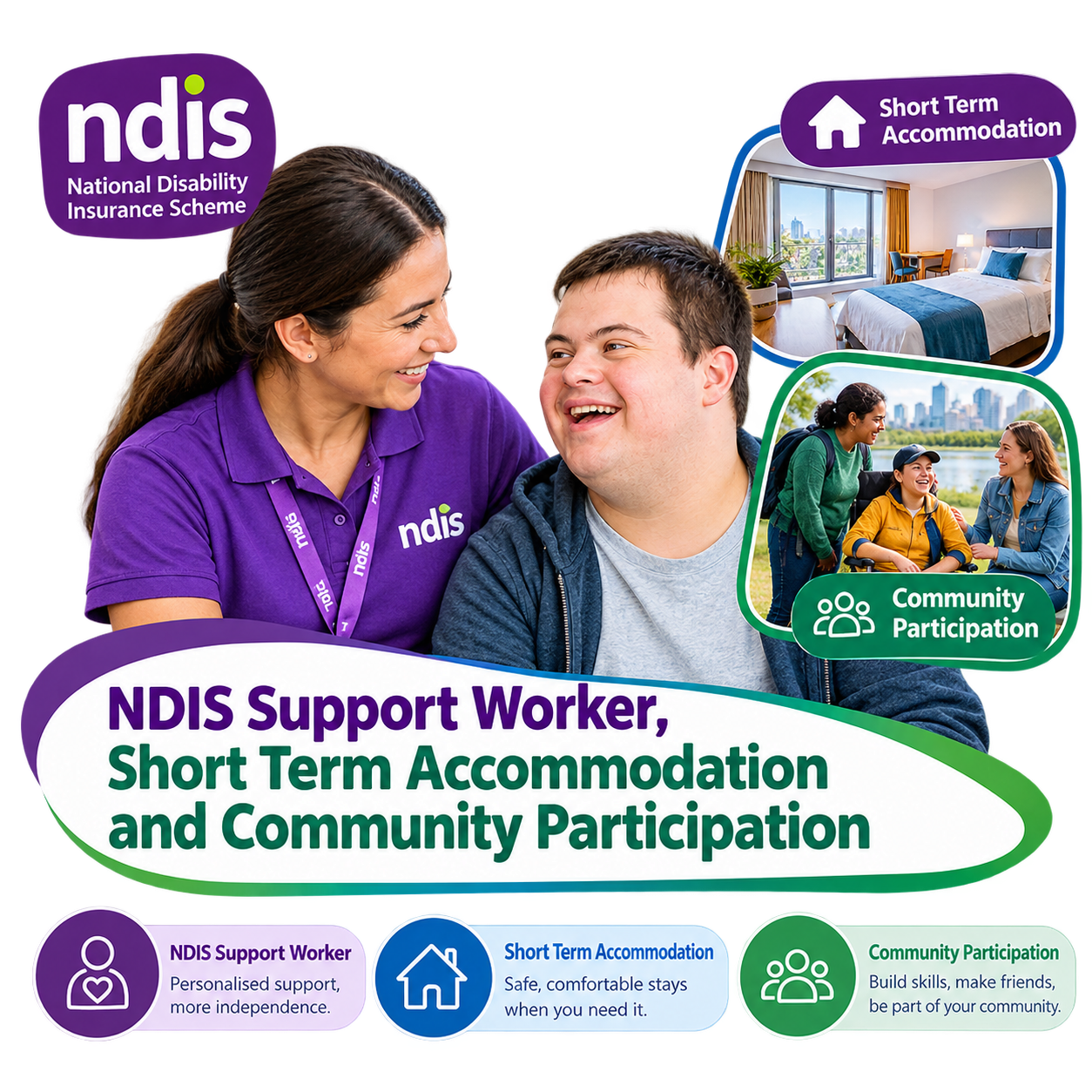
Most NDIS plans mix several supports together, not just one. An NDIS support worker helps with daily routines. NDIS short term accommodation gives a family a planned break. NDIS community participation supports help a participant get out and stay connected to people and places they care about.
On their own, these three can look like unrelated line items in a plan. Together, they usually tell the real story of what “good support” looks like across a week, a month, or a year. This guide covers what each support includes and how they connect. It also covers what to look for in a provider who delivers all three well.
What Does an NDIS Support Worker Actually Do?
An NDIS support worker is a paid, screened professional. They deliver the support set out in a participant’s NDIS plan. The role isn’t a fixed job description — it shapes around the individual. Depending on the plan, it can include personal care, household tasks or transport. It might also cover life skills development or support to take part in community life.
The role is highly individual, so fit matters more than a checklist. A great support worker understands the participant’s routine, communication style and goals, not just the tasks on a plan. Our guide on choosing the right NDIS support worker in Victoria covers this in detail, with a checklist for comparing providers.
What Is NDIS Short Term Accommodation (STA)?
NDIS short term accommodation, sometimes called STA or respite, funds a temporary break from a participant’s usual care arrangements. Often it means a short stay away from home. Sometimes it means extra support in-home, while family or carers get a rest.
NDIS guidance on short term accommodation sets out what it covers: accommodation, and everyday support such as personal care and meal prep. Eligible participants can typically access it for up to 28 days a year, and can use those days flexibly across the plan period.
STA isn’t only about giving carers a break, though that matters too. For participants, it can build confidence outside their usual environment. It can also mean trying new routines with new support workers, and practising independence in a lower-pressure setting. Our complete guide to short term accommodation and respite care in Victoria covers eligibility and inclusions in more depth.
What Is NDIS Community Participation?
NDIS community participation supports help participants take part in social, recreational and community life. That might mean joining a local group, attending an event, learning a new skill, or simply getting out of the house with support.
NDIS guidance on social and community participation frames it around three things: building social skills, working toward personal goals, and connecting with the community. What matters is that it fits the individual, not a one-size-fits-all activity list.
This is often where a support worker’s role and a participant’s community participation goals overlap directly. The worker doesn’t just show up — they actively help the participant get out, try something new, and build genuine connections.
How the Three Supports Work Together
These supports rarely work in isolation. A consistent, well-matched support worker often makes community participation feel achievable rather than daunting. A positive short term accommodation stay can build confidence and routine that carries over into everyday support.
| Support Type | What It Covers | Who It Typically Helps | Where to Read More |
|---|---|---|---|
| NDIS Support Worker | Personal care, household tasks, transport, life skills, day-to-day support matched to plan goals | Participants needing regular, hands-on support at home or in the community | Choosing the right support worker |
| NDIS Short Term Accommodation (STA) | Temporary accommodation and support away from usual care arrangements, up to 28 days/year | Participants and families needing a planned break or a change of routine | Complete STA & respite guide |
| NDIS Community Participation | Social, recreational and community-based activities and outings, matched to personal goals | Participants working on confidence, social connection and independence | Our Community Participation service |
Choosing a Provider That Delivers All Three Well
Providers don’t all handle support worker matching, STA and community participation equally well. Some specialise narrowly. That can leave a participant coordinating between several organisations for supports that would ideally work together. When comparing providers, ask them:
- How do you match support workers to participants? Can that worker also support STA stays or community outings?
- What does a typical short term accommodation stay include? How do you plan it around the participant’s routine?
- How do you identify community participation goals, and how do you measure whether you’re meeting them?
- How quickly do you respond to referrals, and who can submit one?
UnitedTribe provides personalised NDIS support across Victoria, including support workers, short term accommodation and respite, and community participation. We build all three around a single, consistent understanding of the participant, rather than three separate intake processes.
Frequently Asked Questions
1. Can the same NDIS support worker help with community participation and short term accommodation?
Often, yes. Many providers, including UnitedTribe, try to match participants with one consistent support worker. That worker can then support them across different funded supports, rather than bringing in a new worker for every activity.
2. Is NDIS short term accommodation the same as respite care?
The two are closely related. STA is the NDIS funding category. “Respite” describes the break it gives informal carers and family. Providers often use the terms together, as in “Short-Term Accommodation / Respite.”
3. How much NDIS short term accommodation am I entitled to?
This depends on individual eligibility and plan funding. As a general guide, eligible participants can typically access STA for up to 28 days a year. Most participants use those days flexibly, rather than all at once.
4. What counts as an NDIS community participation activity?
The category is intentionally broad. It can include joining a local social group, attending an event, pursuing a hobby, or building confidence catching public transport. The right activities tie back to the participant’s own goals, not a generic list.
5. Do I need a support coordinator to access all three supports?
Not necessarily. A support coordinator can help align a support worker, STA and community participation supports when a plan includes coordination funding. Participants, families, carers and support coordinators can all submit a referral directly.
6. How do I get started with UnitedTribe for these supports?
Submit an online referral. Our team will get in touch, usually within one business day, to talk through what support could look like for you.
Final Thoughts
An NDIS support worker, short term accommodation, and community participation supports each solve a different problem. For most participants and families, the real value shows up when one provider understands the whole picture, not just a single funded category. When comparing providers, ask not just what each support includes, but how well they work together.
Want to talk through what this could look like for you or someone you support? Get in touch with the UnitedTribe team or submit an online referral. We aim to respond within one business day.