
How to Choose the Right NDIS Support Worker in Victoria
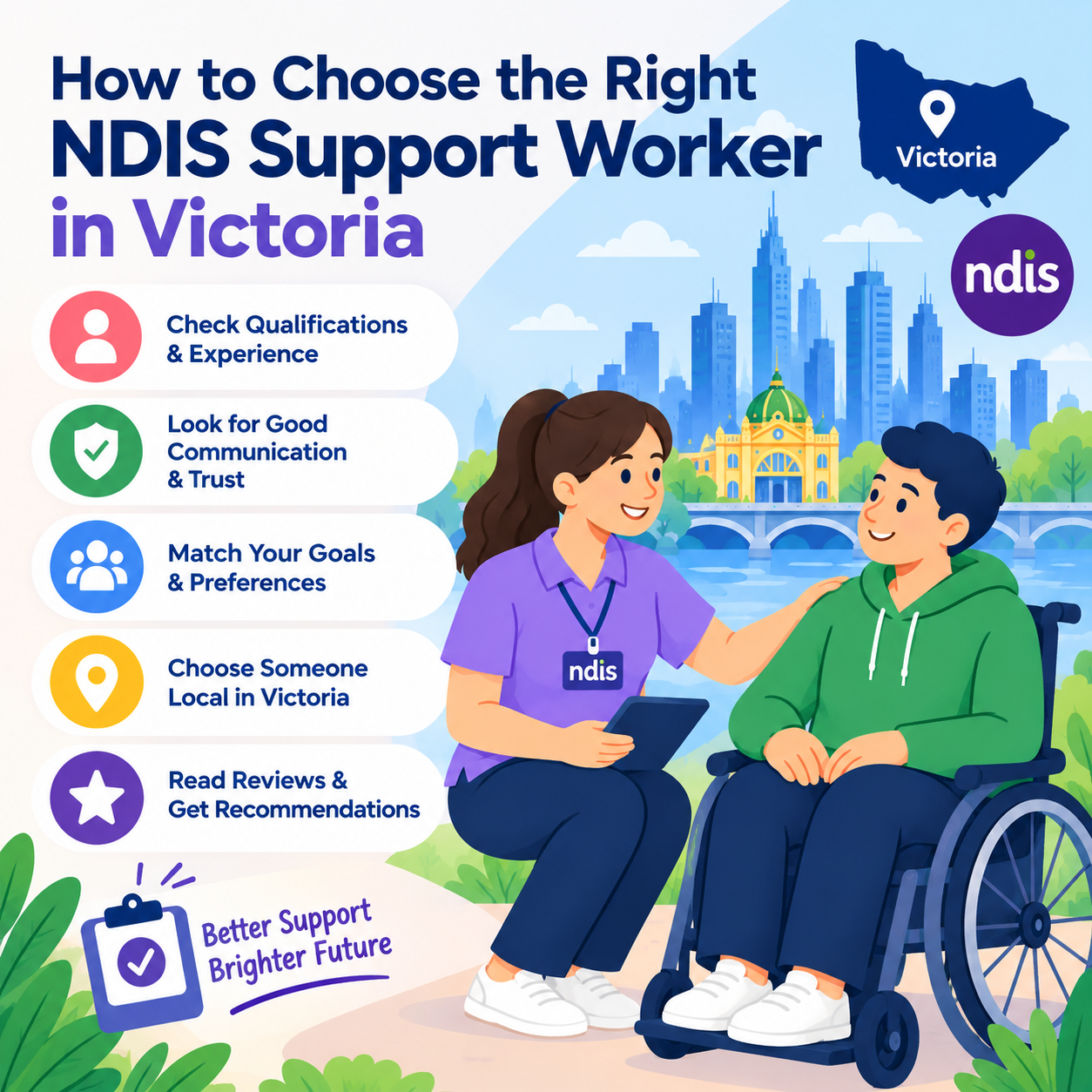
Choosing an NDIS support worker is one of the most personal decisions a participant or family will make. It’s not just about finding someone to complete tasks from a support plan — it’s about finding someone you feel comfortable with in your own home, on your own terms.
If you’re a participant, a family member, a carer, or a support coordinator trying to make sense of your options, this guide walks through what disability support worker NDIS roles actually cover, what separates good NDIS support work from the rest, and the practical steps for finding NDIS support workers who are the right fit — not just the first available.
What Do NDIS Support Workers Actually Cover?
An NDIS support worker’s role is defined by a participant’s individual NDIS plan, not by a fixed job description. That’s part of what makes the role different from many other care or health professions — the tasks change from person to person, based on goals rather than a standard protocol.
Common areas of NDIS support work include:
- Personal care and daily living support
- Household tasks such as cleaning, laundry and meal prep
- Community participation, including social outings and activities
- Transport to appointments, activities or social events
- Life skills development and building independence
- Group and social support for connection with others
Because the work is shaped around the individual, two NDIS support workers in the same team might spend their week doing almost entirely different things, depending on who they’re supporting.
Why “Fit” Matters More Than a Job Title
A common mistake when comparing providers is treating all NDIS support workers as interchangeable, as long as they hold the right qualifications. In practice, fit matters just as much as competence. A support worker who is skilled but doesn’t understand a participant’s routine, communication style or sense of humour can make day-to-day life feel awkward rather than easier.
This is why matching should happen before a shift is ever booked — through a real conversation about the participant’s preferences, goals and what “good support” looks like for them specifically, rather than a generic intake form.
Comparing Your Options: What to Look for in a Provider
Use this table as a quick checklist when comparing agencies or disability support worker NDIS providers:
| What to Check | Weaker Sign | Stronger Sign |
|---|---|---|
| First conversation | Jumps straight to paperwork | Asks about your goals, routine and preferences |
| Worker matching | Assigns whoever is available | Matches based on personality and support needs |
| Communication | Slow or inconsistent replies | Responds within a business day, keeps you updated |
| Flexibility | Rigid, fixed schedule only | Support that adjusts as your needs change |
| Involving family/carers | Excluded from conversations | Included when the participant wants that |
| Community focus | Support limited to the home | Encourages participation outside the home too |
| Referral process | Confusing or unclear | Simple online referral, clear next steps |
If a provider can’t confidently answer how they handle most of these, it’s worth asking more questions before committing.
Qualities of a Strong NDIS Support Worker
Across the board, the NDIS support workers who tend to build the best relationships with participants share a few traits:
- Patience — respecting a participant’s pace, choices and privacy without rushing them.
- Consistency — showing up reliably and communicating early about any changes.
- Active listening — understanding what actually matters to the person, not just what’s on the plan.
- Adaptability — adjusting as goals, health, or circumstances change over time.
- Relevant screening and training — including NDIS worker screening checks and task-specific training.
- Genuine respect for independence — encouraging participants to do more for themselves, not less.
Steps to Finding the Right NDIS Support Worker
- Get clear on your goals first. Personal care, community participation, household support, transport — knowing your priorities makes it easier to compare providers.
- Ask how they match workers to participants. This single question tends to reveal a lot about how person-centred a provider actually is.
- Ask about communication and response times. How a provider communicates before you sign up is usually a good preview of how they’ll communicate afterward.
- Have a conversation before committing. A provider confident in their approach will welcome questions rather than pushing straight to paperwork.
- Submit a referral. Participants, families, carers, support coordinators, plan managers, hospitals and allied health professionals can typically all make a referral directly.
At UnitedTribe, this looks like: submit an online referral, have a conversation with the team, and — if it’s a good fit — get support in place, generally with a response within one business day.
Frequently Asked Questions
1. What’s the difference between an NDIS support worker and a personal carer? A personal carer is often an unpaid family member or friend. An NDIS support worker is a paid, screened professional engaged through a provider, delivering support funded under a participant’s NDIS plan.
2. Do I get to choose my own NDIS support worker? Yes — choice and control are core NDIS principles. Providers should take the time to match you with a worker based on your preferences and let you know if adjustments are needed.
3. What qualifications should an NDIS support worker have? This depends on the type of support. At a minimum, workers should have NDIS worker screening clearance and relevant training for the specific tasks they’ll be doing, such as personal care or manual handling.
4. Can support change if my needs or goals change? Yes. Good NDIS support work should flex over time, with regular check-ins to adjust the type of support and, if needed, the worker providing it.
5. Who is allowed to make a referral for NDIS support? Participants, family members, carers, support coordinators, plan managers, hospitals and allied health professionals can all typically submit a referral, usually through a simple online form.
6. How long does it take to hear back after a referral? This varies between providers, but a reasonable expectation is a response within one business day — a useful early sign of how communication will look going forward.
7. Does UnitedTribe provide NDIS support work across Victoria? Yes, UnitedTribe provides personalised NDIS support across Victoria, including Core Supports such as community participation, personal care, household tasks and transport assistance.
Final Thoughts
The right NDIS support worker isn’t just someone qualified to complete tasks on a plan — they’re someone who understands the person behind the plan. Taking the time to ask the right questions upfront, from how workers are matched to how quickly a provider responds, makes it far easier to find support that actually fits.
If you’re ready to explore support built around you, submit an online referral or get in touch with the UnitedTribe team — we aim to respond within one business day.
One Response