
NDIS provider comparison: United Tribe versus larger national providers for personalised local support
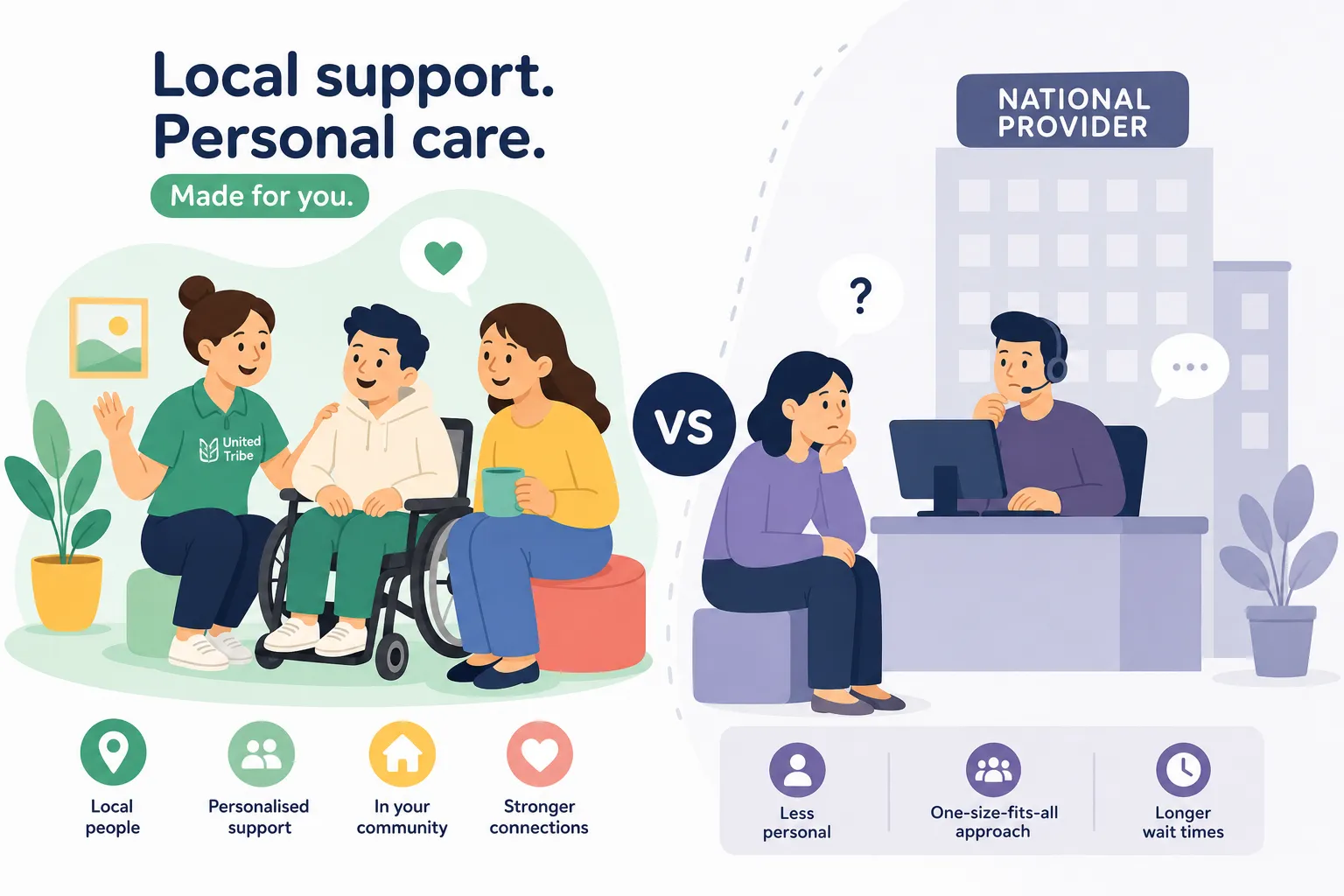
Choosing an NDIS provider in Victoria can feel overwhelming when you search your suburb and find a long list of names in return. Some are large national organisations with call centres, standardised care plans, and dozens of locations across the country. Others are smaller, locally-run services, like United Tribe, that build relationships with participants rather than managing them from a distance. The challenge isn’t finding a provider. It’s knowing which one will actually fit your life.
Price and availability matter, but they’re not the whole picture. The real questions are more personal: who turns up consistently, who remembers the details of your routine, and who treats your goals as goals rather than line items in a care plan. This article walks you through how to make that call well. You’ll learn what separates a genuinely person-centred NDIS service provider from a high-volume one, what Core Supports cover, how to verify any provider’s registration status using the NDIS Provider Finder, and what to look for before you sign a service agreement.
Local versus national NDIS providers: what actually changes day to day
Why scale affects more than just response times
When a large national provider takes you on as a participant, your support is often managed through centralised rostering or standard allocation processes. Workers are assigned based on availability rather than familiarity. That means the person who arrives on Monday morning may not have been briefed on your communication preferences, your routines, or what makes a good support session for you. On paper, the care plan looks consistent. In practice, many participants describe the experience as starting from scratch each week.
Local Victorian providers tend to work differently. Because the team is smaller and embedded in the community, the same workers are more likely to support the same participants week to week. There’s less administrative distance between a participant’s feedback and the person who acts on it. Continuity of support workers is an important quality-of-life factor in disability support, and it’s an area where local providers are often better placed to deliver.
What “person-centred” actually looks like in practice
Person-centred support isn’t just a phrase on a brochure. It means your support worker knows your preferences, knows which community events you enjoy, and checks in when your routine changes. At United Tribe, this kind of relationship is the goal from day one. Consider a Melbourne participant who wanted to rearrange her weekly schedule to attend a Friday social group she’d always been interested in joining. A locally-embedded team has the flexibility to build that kind of adjustment into a regular plan. By contrast, rigid rostering structures at larger organisations can make the same change difficult to accommodate consistently.
The accountability difference with smaller providers
Smaller providers tend to have shorter feedback loops. A concern raised on Monday is addressed by Tuesday rather than routed through a centralised complaints queue. With a close-knit local team, issues surface more quickly because there are fewer layers between participants, their families, and the people making decisions. That proximity also means resolutions tend to come faster, a practical advantage that’s easy to underestimate until you need it.
Core supports to expect from your NDIS service provider in Victoria
Core Supports cover your everyday disability-related needs and daily living assistance. They’re typically the most flexible part of your NDIS plan, and they span four categories: Assistance with Daily Life, Assistance with Social and Community Participation, Consumables, and Transport. Here’s what each of those looks like when a good provider delivers them well.
Personal care and daily living assistance
Personal care and daily living support covers help with grooming, dressing, bathing, and medication, delivered on your terms. Good providers invest time during onboarding to understand what “comfortable” actually means for you as an individual. At United Tribe, support workers spend the first visits listening and observing before establishing a morning routine. That approach might feel unhurried at first, but it produces support arrangements that genuinely fit rather than ones that simply tick the box.
Community participation and social connection
Community participation support is about more than driving someone to an appointment. It’s about enabling real engagement: attending local events, visiting friends, or exploring a new interest. The difference between a good provider and an average one often shows up here, in whether community goals are treated as a consistent part of your plan or handled as one-off requests. That’s the difference between support that accommodates your life and support that merely manages it.
Household tasks and transport assistance
Practical in-home help with cleaning, meal preparation, and laundry keeps your home manageable without compounding fatigue. Transport under Core Supports keeps you connected to appointments, activities, and community events. The best providers integrate transport into the broader support plan from the outset rather than treating it as an afterthought. If getting to your Thursday appointment is part of living your life, it belongs in your plan from the start.
How to find and verify a registered NDIS provider near you
Using the NDIS Provider Finder step by step
It takes one extra step to use the NDIS Provider Finder well, but it’s worth doing. Access it through the NDIS website or the myplace portal, then enter your suburb or postcode and select it from the drop-down list. Choose a support category, such as Assistance with Daily Life or Assistance with Social and Community Participation, and use the filters to narrow your results. You can filter for providers accepting new referrals, open on weekends, or available outside standard hours. The default search radius is 5 kilometres from your address, and you can expand it if your local options are limited. The Provider Finder only shows registered NDIS providers, which gives you a meaningful baseline of confidence before you make contact.
When searching for an NDIS provider near you, the Provider Finder is the right starting point, but it works best when paired with the registration check described below.
Checking registration status and compliance history
The NDIS Commission maintains a public Provider Register where you can search by provider name or ABN and filter for “Approved” registration status to confirm a provider is currently registered. The register also includes a separate compliance and enforcement actions search, which records banning orders, compliance notices, enforceable undertakings, suspensions, and revocations. Check this before signing any service agreement.
A registered provider has passed an independent audit against NDIS Practice Standards, completed suitability assessments for key personnel, and maintained current worker screening clearances. An “Approved” status on the NDIS provider list is a meaningful quality signal, not just an administrative formality. It tells you the provider has been through a genuine assessment process, not simply filled out a form.
What your service agreement should cover (and what to watch for)
The key elements every agreement must include
Every service agreement with an NDIS provider should clearly set out the supports being delivered, including type, frequency, duration, and location. It should also cover pricing and how travel or cancellation costs are handled, start and end dates, how the agreement can be changed or ended, and the process for raising complaints. A provider who pressures you to sign quickly is a provider worth questioning. At United Tribe, walking participants through their agreement before asking for a signature is standard practice, because understanding what you’re committing to is part of respectful support from the outset.
Watch for these red flags when reviewing an agreement:
- Vague support descriptions that don’t specify exactly what you’re receiving
- Extra fees for travel, administration, or cancellations that aren’t clearly explained upfront
- Price-change clauses that allow increases without adequate notice
- Lock-in terms that make it difficult to exit or switch providers
- Cancellation notice periods that don’t align with NDIS pricing rules
Your rights if something goes wrong
You have the right to raise concerns with your provider directly, and if the issue isn’t resolved, to escalate to the NDIS Commission. You also have the right to end the agreement according to its notice terms. Knowing this isn’t something to be anxious about, it’s what lets you speak up early rather than quietly tolerating support that isn’t working for you.
Every registered NDIS provider is required under the NDIS Code of Conduct to have an internal complaints management process in place. A good provider will have a clear and straightforward answer when you ask how concerns are handled. If the answer is vague or defensive, that tells you something worth knowing before you commit.
Practical next steps to get started with United Tribe in Victoria
Starting with a conversation, not a form
Reaching out to United Tribe starts with a conversation, not a form. The team’s first priority is listening: understanding your goals, your daily routines, your preferences, and what good support looks like for you specifically. There’s no pressure to commit to a standard package. The starting point is your life, not a template, and that approach reflects how United Tribe is set up to work.
What happens after your first contact
After your initial conversation, the next steps are straightforward. An informal intake chat is followed by a goal-setting conversation, which can include family members, carers, or your support coordinator if you’d like them involved. From there, a draft schedule is developed before any agreement is signed. The process is designed to give you confidence and clarity rather than create commitment pressure.
Finding the right NDIS provider comes down to fit, not size. A registered, person-centred provider that knows your name, your routine, and your goals is well placed to deliver meaningful outcomes, far more so than one that manages your file from a distance. If you’re in Victoria and want to see what that looks like in practice, get in touch with the United Tribe team to start the conversation.
Ready to find the right support for you or someone you care about?
Speak with the UnitedTribe team about your goals, support needs and what matters most to you. We’ll help you understand the next step and whether our team is the right fit.