
How to Choose the Right NDIS Provider in Victoria: A 2026 Guide
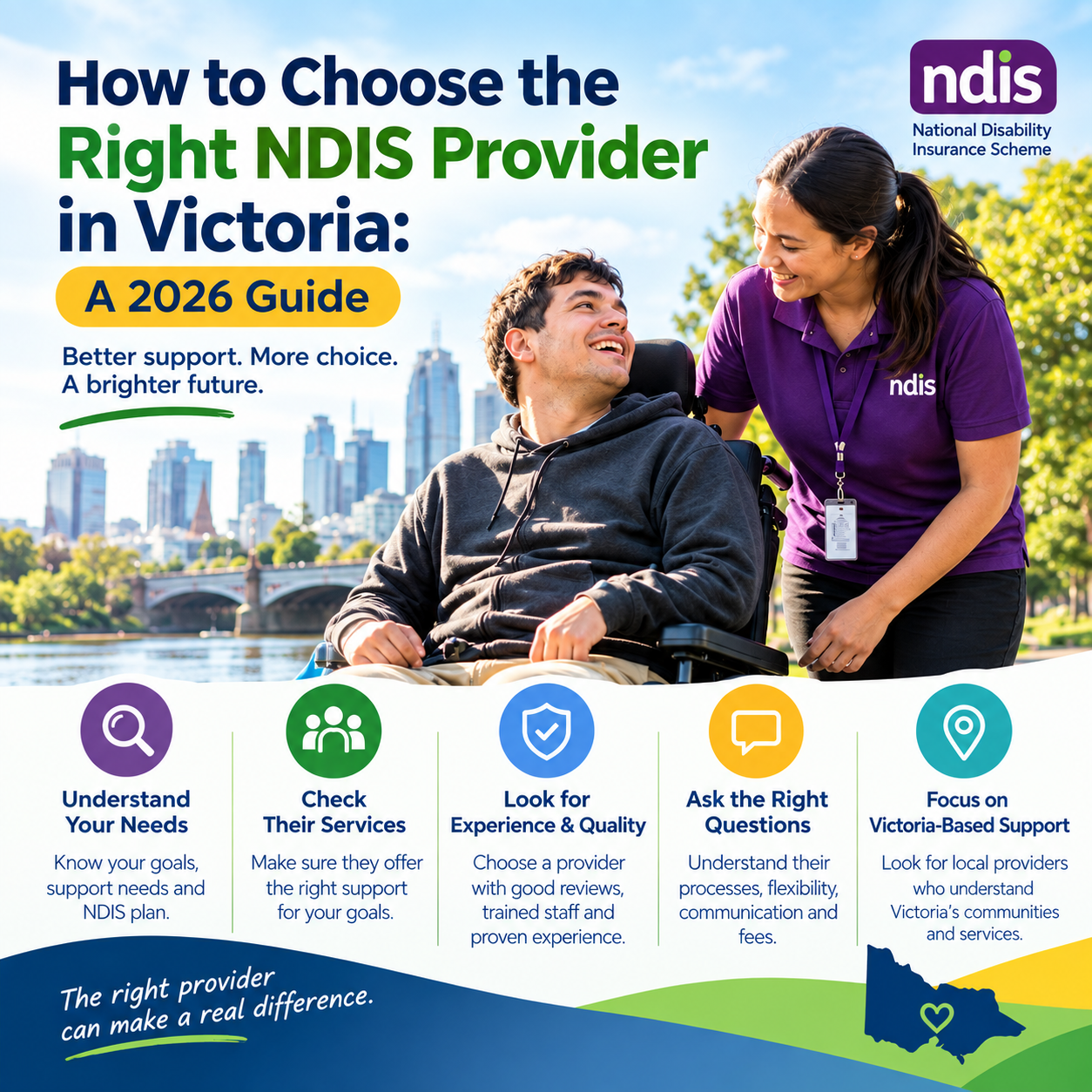
Choosing an NDIS provider is one of the biggest decisions you will make with your plan. The right provider helps you reach your goals. The wrong one can waste your funding and your time.
This guide walks you through the process step by step. You will learn the difference between registered and unregistered providers, what changed in July 2026, and the questions to ask before you sign anything.
Why your choice of NDIS provider matters
Your NDIS plan is built around your goals. That might be living more independently, joining your community, or building daily living skills. A provider turns that plan into real support.
A good provider listens to you. They match you with workers who suit your needs and your personality. They also explain costs clearly and respect your right to change your mind.
In Victoria, you have hundreds of providers to choose from. That choice is a good thing, but it can feel overwhelming. Breaking it into simple steps makes it easier.
What does an NDIS provider actually do?
An NDIS provider is any person, business or organisation that delivers supports funded through your NDIS plan. According to the NDIS website, providers can range from sole traders and allied health professionals to larger support organisations offering services such as personal care, household tasks, community participation and transport assistance.
As a participant, you choose which providers you work with and how your funding is spent, in line with your NDIS plan. This is one of the core principles of the scheme: choice and control stay with the participant, not the provider.
Step 1: Know how your plan is managed
How your plan is managed decides which providers you can use. There are three options, as set out in the NDIS guide to your management options.
- NDIA-managed (agency-managed): You can only use registered providers.
- Plan-managed: A registered plan manager pays your invoices. You can usually use registered or unregistered providers.
- Self-managed: You pay providers yourself. You can usually use registered or unregistered providers.
Check your plan first. If you are not sure, ask your support coordinator or local area coordinator.
Step 2: Understand registered vs unregistered providers
A registered provider has been approved by the NDIS Quality and Safeguards Commission. They are audited against the NDIS Practice Standards. An unregistered provider has not gone through this process, although they must still follow the NDIS Code of Conduct.
| Feature | Registered provider | Unregistered provider |
|---|---|---|
| Audited by NDIS Commission | Yes | No |
| Can support NDIA-managed plans | Yes | No |
| Can support plan- and self-managed plans | Yes | Yes |
| Must follow NDIS Code of Conduct | Yes | Yes |
| Listed on NDIS Provider Finder | Yes | No |
| Can deliver SIL (from 1 July 2026) | Yes | No |
| Formal complaints and incident process | Required | Varies |
What changed in July 2026? From 1 July 2026, providers of Supported Independent Living (SIL) and NDIS digital platforms must be registered. The NDIS Commission explains the details on its mandatory registration page. If you receive SIL, make sure your provider is registered.
Step 3: Make a shortlist
Start with two or three providers. Here are good places to look:
- The official NDIS Provider Finder, which lets you search by suburb or postcode.
- Recommendations from family, friends, or your support coordinator.
- Google reviews and local community groups.
Look for providers who work in your area and offer the services in your plan. You can explore United Tribe’s NDIS services to see what we offer across Victoria.
Step 4: Ask the right questions
A short phone call or meeting tells you a lot. Use these questions:
- Are you a registered NDIS provider?
- Which suburbs and regions in Victoria do you cover?
- How do you match support workers to participants?
- Can I meet my support worker before we start?
- What happens if my regular worker is sick?
- How do you charge, and do you follow the NDIS price limits?
- How do I give feedback or make a complaint?
Listen to how they answer, not just what they say. A good provider is patient and clear.
Step 5: Check your support workers are screened
In Victoria, workers in risk-assessed roles with registered providers need an NDIS Worker Screening Check. Ask your provider to confirm that every worker has a current check. This is a simple step that protects you.
Step 6: Read the service agreement carefully
A service agreement sets out what support you get and how much it costs. The NDIS guide to working with providers says you can negotiate:
- The supports you will receive
- The cost of each support
- How the provider will be paid
- How to change or end the agreement
Never sign an agreement you do not understand. Take it home, read it with someone you trust, and ask questions.
What good support looks like in practice
Support that works well tends to share a few common traits, regardless of which provider delivers it:
- Participants feel heard and respected, not just “managed.”
- Support fits around existing routines rather than replacing them.
- Communication is proactive, not something you have to chase.
- Families and carers are included when it helps, without taking choice away from the participant.
- There’s room to try new things and build independence over time, rather than a fixed, one-size-fits-all plan.
At United Tribe, this is the foundation of how support is delivered across Victoria — starting with a conversation, then building a plan around the person rather than the paperwork. Services span Core Supports, including community participation, personal care, household tasks and transport, with additional supports such as group and social support and community nursing care also available.
Red flags to watch for
Be careful if a provider:
- Pressures you to sign on the spot
- Will not give you a written service agreement
- Charges above the NDIS price limits without explaining why
- Cannot tell you who your support worker will be
- Makes it hard to leave or change services
If something goes wrong, you can report an issue to the NDIS Commission.
Making a referral or switching providers
If you’re a participant, family member, support coordinator, plan manager or allied health professional looking to refer someone for support, the process is generally straightforward: share some details about the person and the support they’re looking for, have a conversation with the provider, and confirm whether it’s the right fit before support begins.
You can find more detail on how this works via our online referral page, or by reaching out directly through our contact page if you’d prefer to ask questions first.
Why Victorians choose United Tribe
At United Tribe, we believe support should feel personal. We take time to understand your goals, your culture, and what matters to you. Then we match you with workers who fit.
We are transparent about pricing and flexible when your needs change. Learn more about our team and how we work.
Ready to find the right support?
Choosing an NDIS provider does not have to be stressful. Know your plan type, compare providers, ask good questions, and read the agreement.
If you want a provider who listens, we would love to chat. Contact United Tribe today for a free, no-pressure conversation about your NDIS plan.
FAQs
Can I change my NDIS provider if I am not happy? Yes. You can change providers at any time. Check your service agreement for the notice period, then let your current provider know in writing.
Do I have to use a registered NDIS provider? Only if your plan is NDIA-managed, or if you receive supports that require registration, such as Supported Independent Living from 1 July 2026. Plan-managed and self-managed participants can usually choose either.
How do I find NDIS providers near me in Victoria? Use the NDIS Provider Finder to search by suburb or postcode. You can also ask your support coordinator or local area coordinator for recommendations.
Do NDIS providers charge extra on top of my plan? Providers should charge within the NDIS price limits for your supports. Any costs must be agreed in your service agreement before support starts.
What should be in an NDIS service agreement? It should list the supports you will get, the cost of each one, how the provider will be paid, and how to change or end the agreement.
Who can refer someone to an NDIS provider? Referrals commonly come from participants themselves, family members, carers, support coordinators, plan managers, hospitals and allied health professionals. Most providers, including United Tribe, accept referrals from any of these sources — see the full list of frequently asked questions here.
How long does it take to hear back after making a referral? This varies by provider, but a reasonable benchmark is a response within one business day. It’s worth asking about response times upfront.
What areas does United Tribe provide support in? United Tribe supports NDIS participants across Victoria, with local teams delivering community participation, personal care and other Core Supports throughout the state.
Is support only available for NDIS participants, or can families get involved too? Support is centred on the participant, but families and carers are welcome to be involved when it helps. Providers should work around what the participant wants, including how much involvement family members have.